By Dean Carney — Founder of ConversionDoc | Conversion Diagnostics & Landing Page Strategy
Ranking on Google and being visible to AI search engines are two completely different things — and most pages are only built for one of them. AI engines like ChatGPT, Perplexity, and Google AI Overviews do not read pages the way Google does. They look for structured answers, entity clarity, and semantic completeness. If your page was built for keyword density and backlinks, there is a good chance AI search cannot retrieve it at all. This article explains the visibility gap, introduces the seven GEO dimensions used to diagnose it, and shows what an AI-ready page actually looks like.
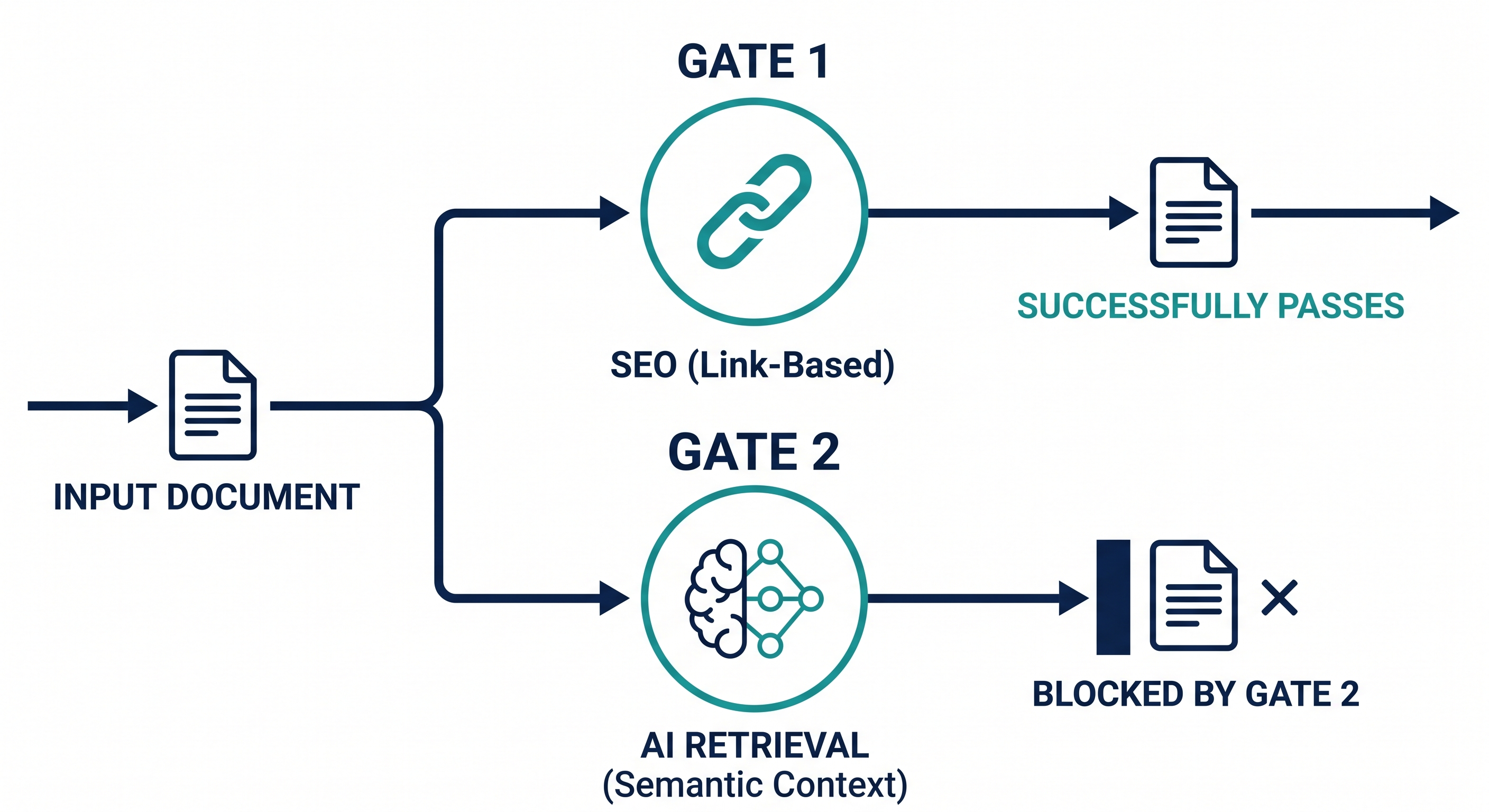
Here is the direct answer: AI search engines cannot retrieve your page because of three structural failures — weak heading hierarchy, no direct-answer content, and unclear entity signals.
These are not SEO problems. Your rankings can be completely intact and all three failures still present.
Google rewards keyword relevance and link authority. AI engines reward clarity, structure, and answerability. Those are different signals. And right now, most pages are only built for one of them.
You Rank. But AI Search Can't Find You.
You have done the work. The page ranks. Traffic comes in.
But something is shifting.
Customers are asking questions in ChatGPT and getting answers that do not include you. Perplexity is summarising your market and citing your competitors. Google AI Overviews are answering the exact questions your page was built to rank for — without linking to it.
This is not a rankings problem. Your Google position may be completely intact.
It is a retrieval problem. AI engines are looking for something your page is not giving them.
The gap between where your customers are searching and where your page is optimised to appear — that is the visibility gap. And for most businesses, it is widening every month.
⚠️ Warning: This is not a future problem. Google AI Overviews are already live across major markets. ChatGPT has over 300 million weekly active users . Perplexity reached 15 million active users and is growing rapidly as a research and discovery tool. The shift is not coming — it is already affecting how your customers find you.
How AI Engines Read Pages Differently
Google built its dominance on link authority and keyword matching.
Point enough links at a page with the right words on it, and it ranks.
AI search engines operate on a fundamentally different model. They are not matching keywords. They are extracting answers.
They read a page the way an intelligent researcher would — looking for clear topic focus, direct responses to likely questions, well-structured information hierarchy, and enough semantic depth to treat the page as genuinely authoritative on its subject.
A page structured around SEO rather than comprehension is difficult for an AI engine to parse. It cannot easily extract a clear answer. It cannot confirm what the page is definitively about.
So it does not cite it.
The 7 GEO Dimensions: A Diagnostic Framework
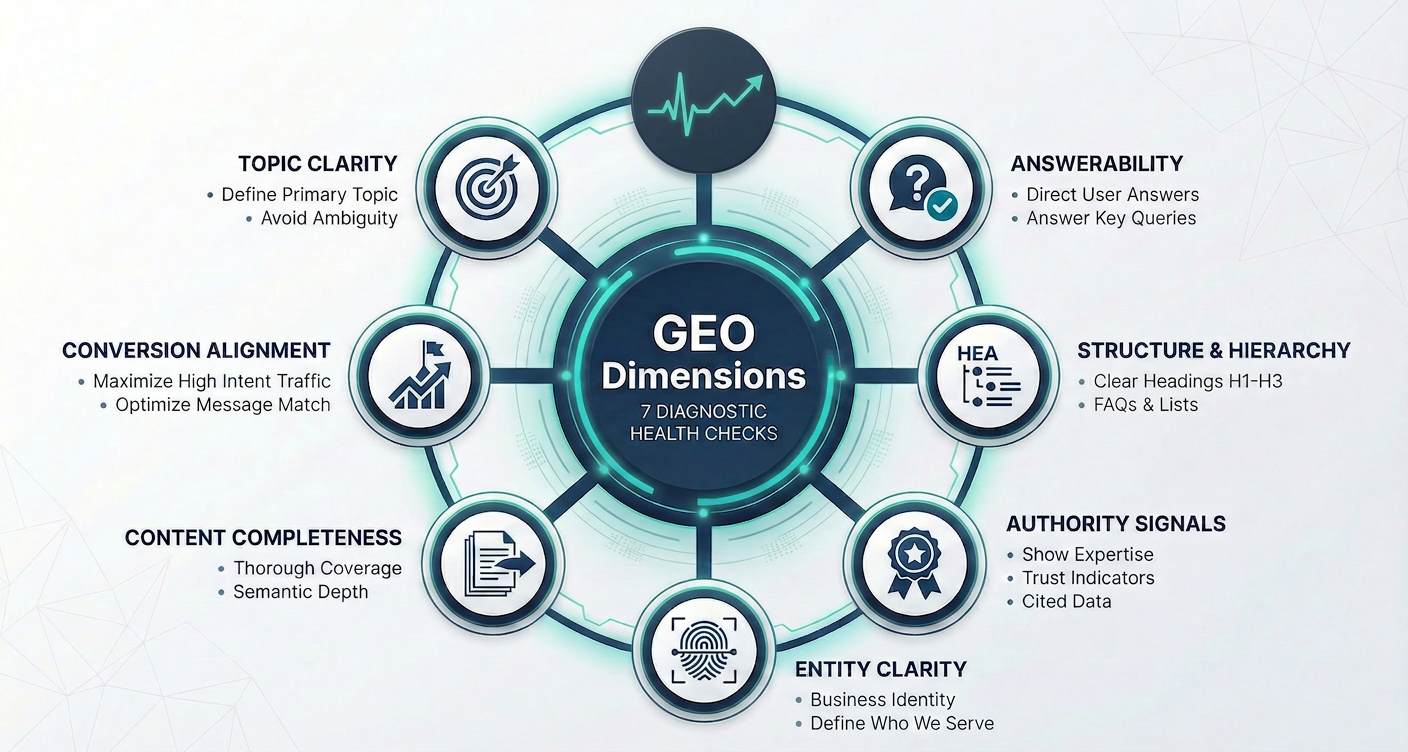
Every GEO audit I run at ConversionDoc assesses pages across seven dimensions.
Not as a checklist — as a diagnostic framework that identifies exactly where the visibility gap is and what is causing it.
- Topic Clarity: Is the primary topic defined instantly? Can AI understand "Who We Serve"?
- Answerability: Does the content directly answer user questions, or is it buried in fluff?
- Structure & Hierarchy: Are H1-H3 headings descriptive? Are FAQs and lists present?
- Authority Signals: Is there cited data, expertise, and verifiable trust indicators?
- Entity Clarity: Is the business identity explicit and consistent across the page?
- Content Completeness: Is the topic covered with enough semantic depth for AI to treat it as a source?
- Conversion Alignment: Is the message match optimized for high-intent traffic arriving from AI?
In almost every audit I run, pages have structural gaps across three or four of these dimensions simultaneously. The SEO work is solid. The GEO foundation is almost nonexistent.
The Three Gaps That Make Pages Invisible to AI
Of the seven dimensions, three failures appear most consistently on pages that rank well but cannot be retrieved by AI engines.
Weak heading hierarchy.
Google can infer topic relevance from keywords scattered throughout a page. AI engines rely much more heavily on heading structure to understand what a page covers and how the information is organised.
Vague headings like "Our Approach" or "Why Choose Us" tell an AI engine almost nothing.
Descriptive headings like "How the 7-Pillar Conversion Framework Diagnoses Landing Page Failures" give it a clear, extractable signal.
In almost every GEO audit I run, the heading structure is the first thing that breaks. Founders write headings for humans skimming a page — not for AI engines parsing information hierarchy.
No direct-answer content.
AI engines are built to answer questions. They look for pages that do the same — in plain language, close to the question itself.
Long-form narrative content, however well-written, does not serve this function well. A page that takes four paragraphs to reach the answer it could deliver in two sentences is a page an AI engine will struggle to cite confidently.
💡 Pro Tip: FAQ sections are one of the most GEO-effective elements you can add to any page. Each question-and-answer pair is a discrete, extractable unit that AI engines can retrieve and surface directly. If your page does not have one, adding it is one of the highest-leverage GEO improvements available.
Unclear entity signals.
This is the most underdiagnosed gap I see.
An AI engine needs to know — with confidence — who is behind this page, what they specifically do, and who they serve. If that information is inconsistent, buried, or implicit rather than explicit, the engine cannot comfortably attribute authority to the page.
A business name mentioned once in a footer. A "we help businesses grow" value proposition. A product description that could apply to twenty different tools.
These are entity clarity failures. And they are extremely common on pages that were built for conversion rather than comprehension.
What an AI-Ready Page Actually Looks Like
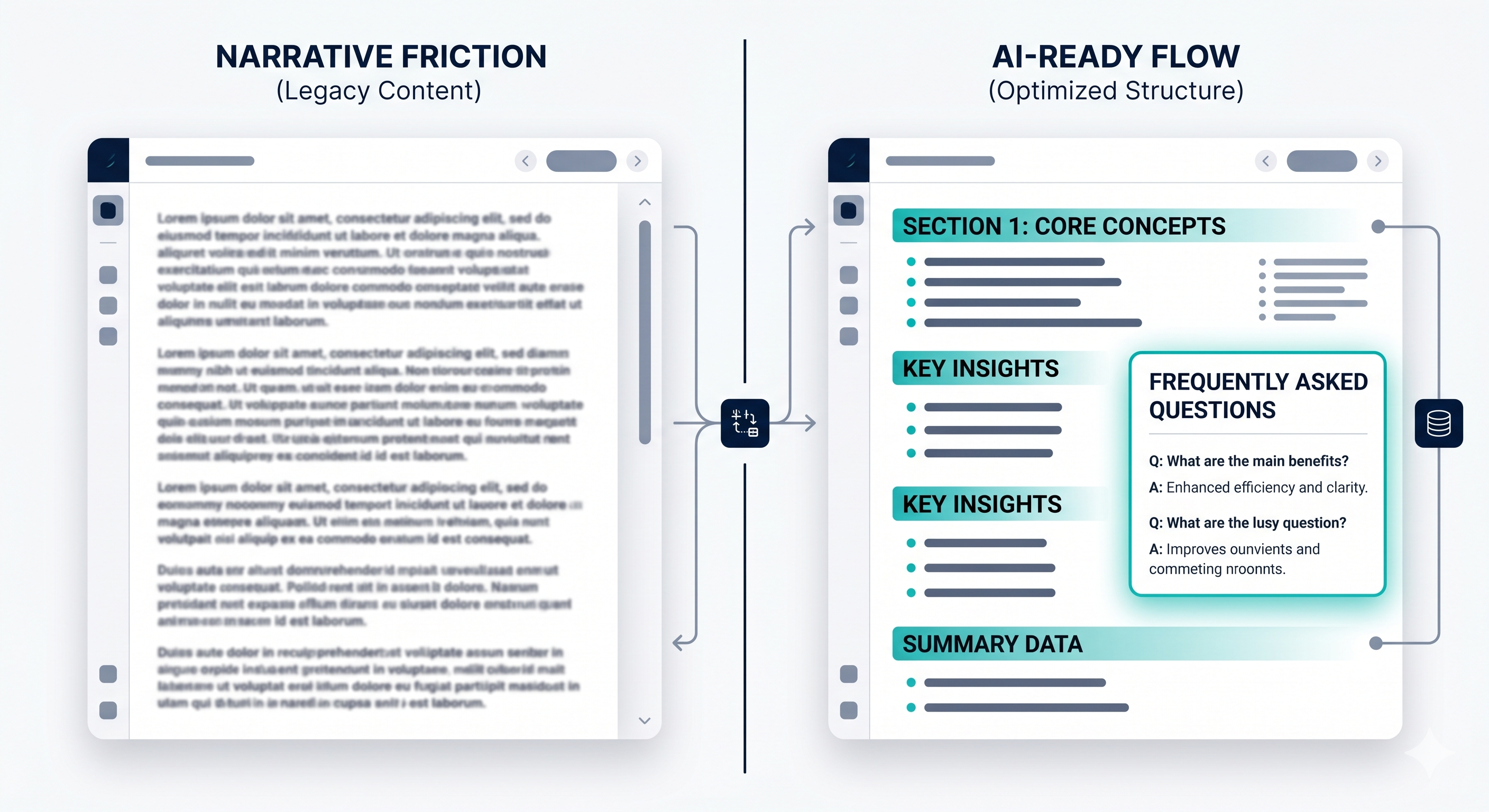
An AI-ready page is not a different kind of page. It is a clearer version of the page you already have.
The heading structure tells a complete story at a glance. The content answers likely questions directly and early. The entity — who you are, what you do, who you serve — is explicit and consistent.
There is enough semantic depth for an AI engine to treat the page as genuinely authoritative.
And the content is structured for extraction — summaries, lists, FAQs, direct answers — rather than requiring the AI to mine meaning from dense paragraphs.
💡 Pro Tip: Run the simplest possible GEO test on your own page. Paste your URL into ChatGPT or Perplexity and ask: "What does this business do and who is it for?" If the answer is vague, incomplete, or wrong — your page has an entity clarity or structure problem that is costing you AI visibility right now.
The Over-Optimisation Paradox: Why Your Volume is Killing Your Visibility
The conventional wisdom says more content equals more visibility. We’ve been trained to stack keywords, expand semantic clusters, and pad word counts to "prove" authority to Google.
The 2026 Reframe: In the retrieval era, over-optimisation is a visibility death trap.
AI engines (LLMs) don't have infinite patience. They are looking for a high signal-to-noise ratio to extract a confident answer. When you pad a page with forty related keyword variations, you don't look "authoritative"—you look "unfocused."
Signal vs. Noise
If an AI engine cannot determine exactly what your page is the definitive source for, it will default to a competitor who is clearer and more specific. Content "fluff" acts as a lead shield, blocking the AI's ability to see your core entity markers.
📌 Precision Over Volume
Deleting 20% of the introductory "filler" or unfocused content on a page often improves AI retrievability more than writing three new sections ever will. In the retrieval era, your signal-to-noise ratio is more important than your total word count.
The 20% Delete Rule
In practice, I have found that the highest-leverage GEO move isn't adding content—it's pruning it. The ranking game rewarded volume; the retrieval game rewards precision. If a paragraph doesn't answer a query or define your entity, it is actively working against your visibility.
3-Step AI Visibility Sprint
Before running a full audit, these three changes will produce the largest visibility improvement for the smallest investment of time.
Step 1 — Rewrite your headings. Go through every H2 and H3 on the page. If any of them could appear on a page about a completely different topic, rewrite them. Descriptive headings are the single fastest structural improvement for AI retrievability.
Step 2 — Add or expand your FAQ section. Write five to eight questions a potential customer would genuinely ask about your product or service. Answer each one directly and completely in two to four sentences. Place the FAQ section above the fold if possible — or at minimum, clearly signposted in the page structure.
Step 3 — Make your entity signals explicit. In the first 150 words of your page, make sure it is clear who you are, exactly what you do, and who you serve. Do not make an AI engine infer it. State it directly. Then make sure the same information is consistent across your homepage, about page, and any other key pages.
These three steps will not fully close the visibility gap. But they will move you from invisible to retrievable — which is the most important first step.
Quick Diagnostic: Is Your Page Invisible to AI Search?
Run through these before assuming your SEO work covers you:
- Do your H2 and H3 headings describe the content beneath them specifically — not generically?
- Does your page directly answer at least three questions a potential customer might ask?
- Is there an FAQ section with clear, complete answers?
- Is it explicitly stated who your business is, what it does, and who it serves — above the fold?
- Is your content deep enough on its topic for an AI engine to treat it as authoritative?
- If you paste your URL into ChatGPT and ask what the business does, does it get it right?
- If AI sends traffic to this page, is the next step clear enough to convert that visitor?
If you answered no to two or more, your page has a GEO visibility problem that SEO alone will not fix.
Frequently Asked Questions
Is GEO the same as SEO? No — though they overlap. SEO is primarily about ranking in traditional search engines through keyword relevance and link authority. GEO (Generative Engine Optimisation) is about being retrieved, understood, and cited by AI search engines like ChatGPT, Perplexity, and Google AI Overviews. The signals are different. A page can rank well on Google and be almost completely invisible to AI search — and increasingly, both matter.
Does Google's AI Overview use the same signals as traditional Google ranking? Not entirely. Google AI Overviews prioritise pages that directly answer the query in a clear, structured way — not just pages that rank for the keywords involved. It is possible to rank on page one for a query and not appear in the AI Overview for the same query. Structure and answerability matter more in the AI layer than they do in traditional ranking.
Can fixing GEO issues hurt my existing Google rankings? In almost every case, no. The changes that improve AI search readiness — clearer headings, more direct answers, better content structure, explicit entity signals — are also positive signals for traditional search. GEO improvements tend to lift SEO performance as well, not undermine it.
How do I know if my page has an entity clarity problem? The simplest test is to paste your page URL into ChatGPT or Perplexity and ask: "What does this business do and who is it for?" If the response is vague, incomplete, or inaccurate — your entity signals are not clear enough for AI engines to retrieve you confidently. The fix is almost always in the first 150 words of the page.
Where do I start if I want to improve my AI search visibility? Start with the three highest-impact fixes: rewrite your heading structure to be descriptive rather than generic, add or expand your FAQ section with direct answers to likely customer questions, and make sure your entity signals — who you are, what you do, who you serve — are explicit and consistent across the page. These three changes will produce the largest visibility improvement for the smallest investment of time.
What to Do Next
Before you commission more content, adjust your keyword strategy, or brief another round of SEO work — find out where your page actually stands with AI search.
The visibility gap is real. It is structural. And it is fixable — once you know exactly where it is.
Run a free GEO audit on your page at ConversionDoc. You will get an AI Search Readiness score across seven dimensions, your top three visibility fixes, and a clear picture of where your page is invisible to AI engines — in 60 seconds.
Written by Dean Carney, Founder of ConversionDoc. Conversion strategist helping founders, freelancers, and agency owners diagnose why their pages aren't converting — and fix them.