By Dean Carney — Founder of ConversionDoc | Conversion Diagnostics & Landing Page Strategy
Most pages lose visitors not because the offer is weak, but because trust hasn't been established before the reader processes the offer. First-time visitors arrive suspicious, not curious. The pages that convert feel the most credible the fastest — and credibility is decided before your headline is read. This article breaks down the trust hierarchy, where each signal belongs on a page, and what the absence of each one actually costs you.
You Don't Have a Clarity Problem. You Have a Credibility Problem.
The offer is there. The headline makes sense. The copy explains what you do. But people still leave.
Most founders assume this is a clarity issue and rewrite the copy. Some assume it's a traffic problem and change the ads. Almost none of them look at trust. That's the real leak.
A first-time visitor doesn't arrive ready to buy. They arrive ready to leave. They're scanning for reasons to dismiss you, not reasons to commit. If the page doesn't signal credibility in the first few seconds, the decision is already made — and no amount of good copy below the fold will undo it.
Your competitor isn't necessarily better. They just look more trustworthy. That's what's beating you.
Why Trust Decides Before Copy Does
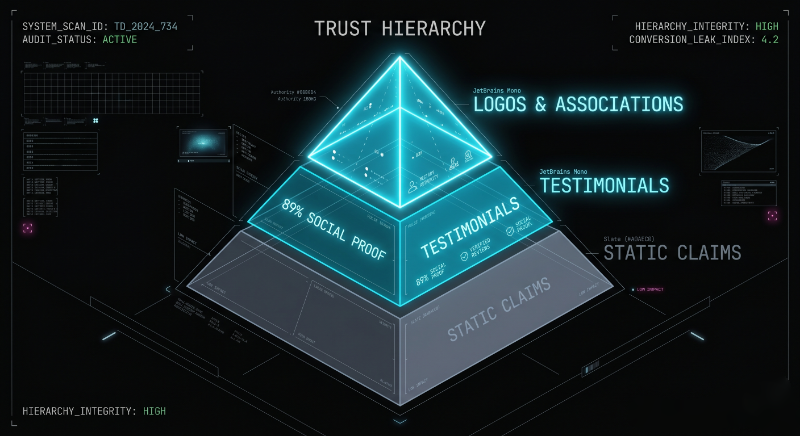
Here's the thing most conversion advice gets wrong: visitors make a credibility judgement before they've read a single word of your copy.
Cognitive fluency research shows that the brain processes familiarity and coherence almost instantly. A page that feels professionally assembled signals safety. A page that feels sparse or inconsistent signals risk. This happens before your headline has been read. Before your value proposition has been processed.
Trust is the pre-condition. Clarity is what converts once trust exists.
The common advice — "lead with a strong headline" — isn't wrong. It's just incomplete. If the page doesn't feel credible on arrival, most visitors never engage seriously with the headline in the first place.
The trust hierarchy runs like this: logos and recognisable associations beat outcome-specific testimonials, outcome-specific testimonials beat direct claims, and direct claims beat nothing. Most pages lead with claims. The pages that convert lead with proof.
💡 Key Insight: Never lead with a claim you can't anchor to a specific result or a recognisable name. "The world's best software" is a claim. "Used by the ops team at Notion" is proof. One of these earns the right to be read. The other invites scepticism.
What the Trust Gap Actually Looks Like
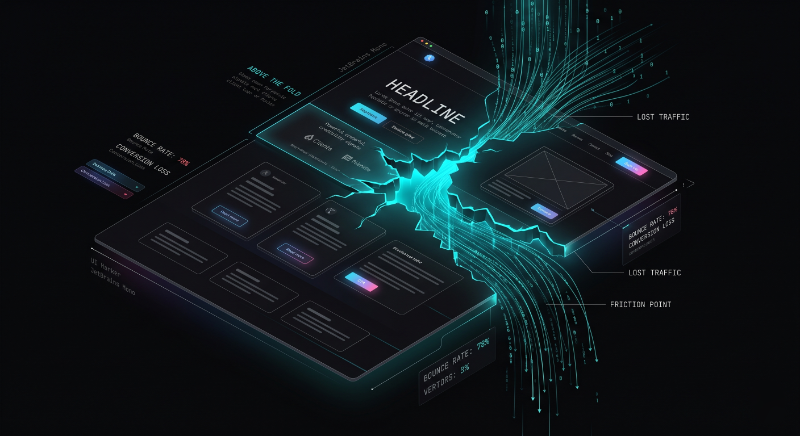
I see this constantly across SaaS pages, course creators, and solo consultants. The page is technically complete — headline, subhead, CTA, features section. What's missing is proof that anyone else has done this before you and found it worth doing.
The absence of trust signals doesn't leave the page neutral. It actively reads as suspicious.
Here's how it typically shows up:
No logos, no names, no faces. "Trusted by hundreds of founders" with zero evidence is worse than nothing. The claim invites scepticism instead of resolving it.
Testimonials that say nothing specific. "Great product, really helpful" is not a testimonial. It's filler. Vague praise doesn't transfer trust — it reads as invented. A visitor who suspects you've fabricated it leaves more suspicious than when they arrived.
No risk reducer. No guarantee, no free trial, no clear refund policy. Without one, the perceived cost of being wrong stays high. People don't commit to things they might regret with no way out.
Proof buried below the fold. Even when trust signals exist, they're often hidden. A press mention in the footer. A testimonial after three sections of features. By the time the reader reaches it, they've already decided.
⚠️ Warning: Five vague testimonials are less persuasive than one specific, outcome-based one. Volume doesn't signal credibility — specificity does. Audit your social proof. If a testimonial doesn't describe what changed, it's doing no work.
The Fix: Right Signals, Right Places
This isn't about adding a testimonials section. It's about placing the right trust signals at the right moments in the reader's journey.
Put a credibility anchor above the fold. The first thing a visitor should encounter — before they've committed to reading — is evidence they're in the right place. One of: a recognisable logo strip, a specific social proof stat, or a single high-quality testimonial from a source they'd recognise. The goal isn't to persuade. It's to earn the right to be read.
Replace vague praise with outcome testimonials. The format that converts is simple: who they are, what they had before, what changed after. "I was getting 30 visits a day with zero sign-ups. After fixing the page, I'm at 8% conversion" is a testimonial. "Really useful tool, would recommend" is noise. One specific, outcome-based testimonial outperforms five generic ones every time.
Add a risk reducer near the CTA. The CTA is where perceived risk is highest. A clear, specific guarantee — placed directly below or adjacent to the button, not buried in an FAQ — removes the final objection before it forms. Answer "what if this doesn't work?" at the exact moment it enters the visitor's mind.
Move your best proof up. If your strongest trust signal is below the fold on mobile, most visitors will never see it. This is one of the most common and most avoidable trust leaks I find on pages. A first-time visitor should see evidence of credibility before they have to work for it.
The Proof Paradox: Why Polished Testimonials Erode Trust
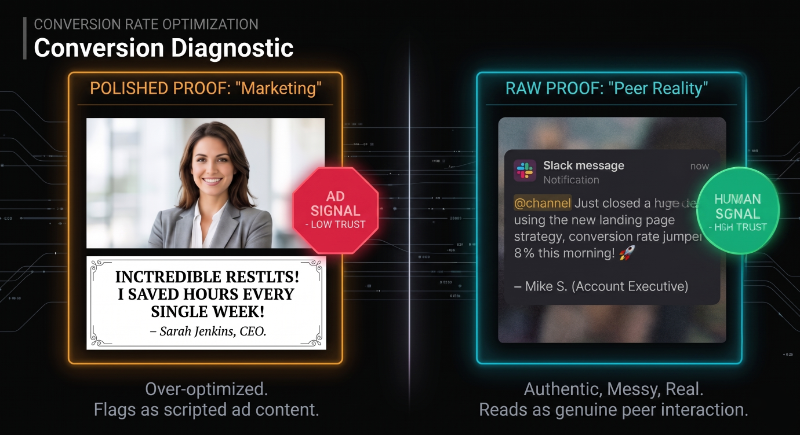
Here's something most conversion advice won't say: highly produced social proof can erode trust rather than build it.
When a testimonial looks like a professional studio shoot — perfect lighting, branded lower thirds, scripted delivery — the brain flags it as ad content. When it's a raw screenshot of a Slack message, a LinkedIn comment, or an unedited voice note, the brain flags it as peer reality.
The format signals the origin. Polished signals marketing. Raw signals genuine.
This doesn't mean abandon quality. It means stop trying to make your proof look pretty when making it look real would work harder. A customer screenshot with typos and an uneven crop can out-convert a professionally edited video testimonial — because it reads as something a real person actually sent, not something your brand team staged.
The practical implication: when you have raw, unedited proof, use it. Don't sanitise it into something that no longer looks like it came from a real person.
What This Looks Like in Practice
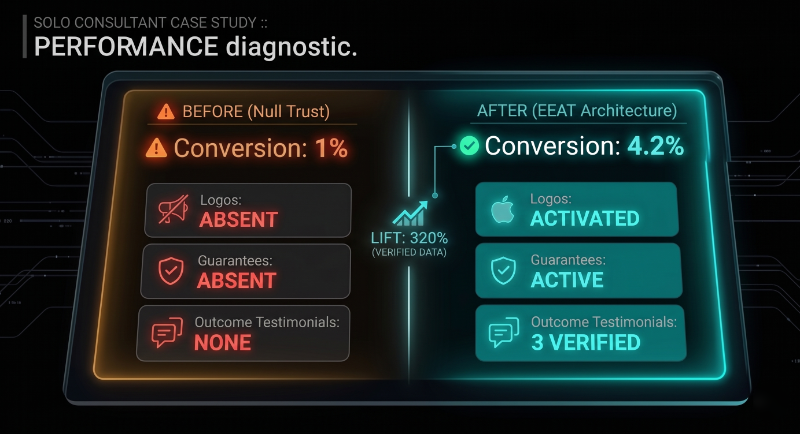
A solo consultant had a strong offer and good copy. Conversion was sitting under 1%. The page had no testimonials, no recognisable logos, no risk reducer — just a well-written explanation of what they did.
Three changes: a specific testimonial from a recognisable industry name above the fold, a money-back guarantee directly below the CTA, and a small "as seen in" strip with two relevant publications.
No copy changed. No design overhaul. Conversion moved to just over 4%.
The offer didn't get better. The page got credible.
Quick Diagnostic
Run this before your next copy pass. Trust issues should be fixed before messaging issues.
☐ Does your page have any social proof visible without scrolling?
☐ Are your testimonials outcome-specific — do they show what changed, not just that it was good?
☐ Is there a risk reducer near your CTA — not in the footer, not in the FAQ?
☐ Do you have a credibility anchor above the fold?
☐ Can a first-time visitor find proof within five seconds on mobile?
☐ Do any of your testimonials look so polished they could be mistaken for ad copy?
☐ If your testimonials disappeared, would the page still feel credible?
☐ Does your proof match the specific scepticism of your target buyer?
Frequently Asked Questions
How many logos do I need for a "trusted by" strip? Relevance beats quantity. Three logos from companies your target audience recognises outperform ten logos from unknown startups. Your visitor needs to see something familiar — the recognition is what transfers trust, not the number.
Should I use video testimonials or text? Both where possible, but don't overlook raw formats. A short, unedited clip of a customer describing a specific result — recorded on a phone, without production — often reads as more credible than a polished video. The rawness signals it came from a real person, not a marketing team.
Where is the best place to put a money-back guarantee? Directly adjacent to the CTA. You want to answer "what if this doesn't work?" at the exact moment it forms in the visitor's mind — not three scrolls later in an FAQ section.
Does social proof work for brand-new products with no customers yet? Yes. If you don't have customers, use expert or framework-level proof. Cite the research your approach is built on. Reference credible names in your space who validate the problem you're solving. Borrowed authority is still authority — until you have your own data to replace it.
The Page That Looks Credible Wins
The trust gap is silent. Visitors don't leave a note saying they didn't believe you. They just leave.
Most founders spend their energy making the page clearer. That matters. But clarity earns conversion only after credibility earns attention. Fix the trust signals first. Then fix the message.
If you want to see exactly where the trust gap is on your page — which signals are missing, where they should go, and what they're costing you — It takes 60 seconds.
Written by Dean Carney Founder of ConversionDoc. Conversion strategist helping founders, freelancers, and agency owners diagnose why their pages aren't converting — and fix them. Connect on LinkedIn →