By Dean Carney — Founder of ConversionDoc | Conversion Diag
nostics & Landing Page Strategy
Google ranking and AI search visibility operate on completely different logic. A page can sit at position one on Google and be entirely invisible to ChatGPT, Perplexity, and Google AI Overviews — because those engines don't retrieve content the way Google indexes it. This article explains the structural reasons why, shows exactly which page elements AI can and can't read, and gives you a concrete checklist to close the gap.
Your Google Ranking Means Nothing to ChatGPT
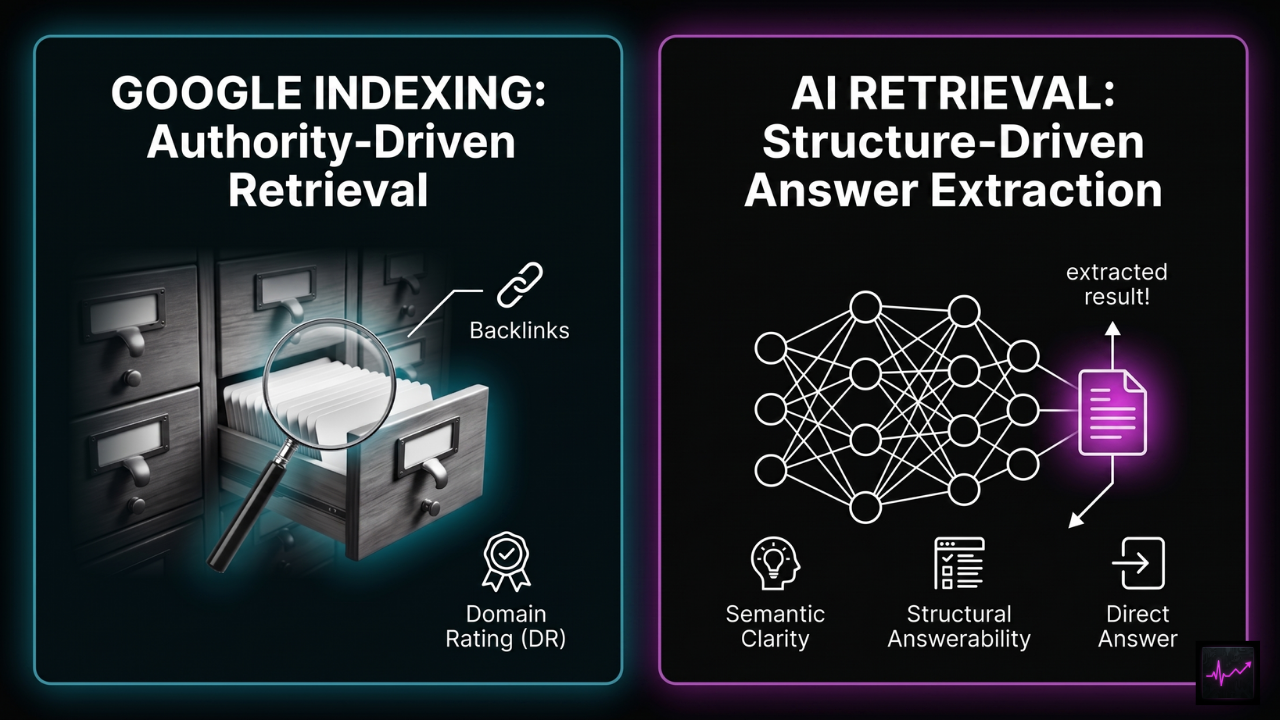
You've done the work. The page ranks. Traffic comes in from search. By every traditional SEO metric, the page is performing.
Then someone asks ChatGPT a question your page should answer perfectly. It cites three competitors. Your page isn't mentioned.
This isn't a fluke. It's structural.
AI search engines — ChatGPT, Perplexity, Google AI Overviews — don't retrieve content the way Google indexes it. Google rewards authority signals: backlinks, domain strength, keyword relevance, click-through behaviour. AI engines retrieve content based on something different entirely: whether the page can be read, understood, and summarised by a machine that needs to produce a confident, direct answer.
A page optimised for one system is not automatically optimised for the other. Most pages aren't optimised for both. That's the gap.
How AI Engines Actually Retrieve Content
To understand why your page gets skipped, you need to understand what AI engines are actually doing when they process a query.
When someone asks Perplexity "what's the best way to reduce churn for a SaaS product," the engine isn't running a keyword match. It's looking for pages that directly answer that question — pages with clear structure, unambiguous headings, and content that can be extracted and summarised without interpretation.
The engine is looking for retrievability. Not rank.
This is how retrieval-augmented generation works: the system pulls chunks of content from indexed pages and surfaces the ones that are clearest, most direct, and most semantically complete — regardless of the domain authority behind them. A page with weak backlinks but strong structural clarity will be cited over a high-authority page that buries its answer in persuasive copy.
Three things determine whether a page is retrievable:
Semantic clarity — is it obvious what this page is about, who it's for, and what it's saying? Not from the metadata. From the content itself.
Structural answerability — does the page directly answer the kinds of questions people ask? Is that answer easy to find without reading every word?
Entity recognition — does the page make it clear who the business is, what they do, and who they serve? Consistently, not just in one paragraph?
Google can infer a lot from signals outside the page. AI engines work primarily from what's on it. That distinction changes everything about how a page should be built.
💡 Key Insight: AI engines don't care how many backlinks your page has. They care whether a machine can read it, extract a clear answer, and cite it confidently. Authority signals that took years to build are irrelevant to a system that works from content alone.
The Page Elements AI Can and Can't Read
This is where most pages fail. They're built for a retrieval logic that AI engines don't use.
Headings — the single most important structural element
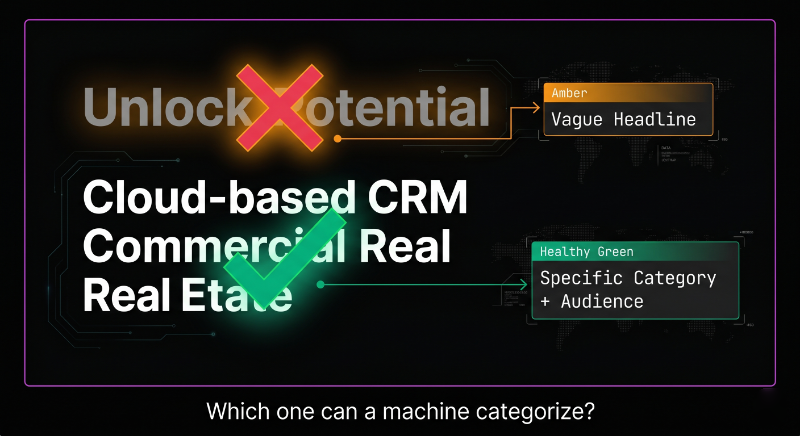
AI engines use heading structure to understand what a page covers and how the content is organised. An H1 that says "Solutions" tells an AI engine almost nothing. An H1 that says "Churn Reduction Strategies for Early-Stage SaaS" tells it exactly what the page covers, who it's for, and what question it might answer.
I see this constantly on SaaS pages. The headings are designed to sound compelling to a human reader. "Supercharge your growth." "Work smarter." These headings are invisible to AI retrieval — they carry no semantic information. A machine reading that heading has no idea what the product does.
Descriptive headings that mirror how people phrase questions are the single highest-leverage fix for most pages. It costs nothing to change "How It Works" to "How ConversionDoc Diagnoses Landing Page Problems." The second version is retrievable. The first is noise.
Direct answers — the content AI engines extract
AI engines are looking for content they can lift and use. That means direct answers, placed early, written plainly.
Most pages bury the answer. The hero section sells. The features section lists. The benefits section elaborates. By the time the page actually answers the question a visitor — or an AI engine — came with, it's three scrolls down and wrapped in persuasive framing that makes it hard to extract.
A page that answers "what does this product do and who is it for" in the first two sentences of the body copy is dramatically more retrievable than a page that takes four sections to get there.
FAQ sections — underused and highly retrievable
FAQ sections are one of the most effective structural elements for AI retrieval and almost nobody takes them seriously. They're treated as an afterthought — a few generic questions dumped at the bottom of the page.
AI engines cite FAQ content heavily. A well-structured FAQ that answers real questions people ask — phrased the way people actually phrase them — gives an AI engine pre-packaged answers it can retrieve directly. It's the closest thing to writing content specifically for AI retrieval without abandoning the human reader.
Vague entity signals — the invisible brand problem
If an AI engine can't clearly identify who you are, what you do, and who you serve from the content of the page, it can't cite you confidently. It will cite the page where those things are unambiguous instead.
This is a surprisingly common problem. The brand name appears. The product is described. But who it's for, what problem it solves specifically, and what makes it distinct — these things are implied rather than stated. A human reader picks up the implication from context. An AI engine needs it stated directly.
⚠️ Warning: A page that ranks on Google because of domain authority can still be completely invisible to AI retrieval. Backlinks don't transfer. Domain strength doesn't transfer. What transfers is structural clarity — and most pages weren't built with that in mind.
The Retrieval Gap in Practice
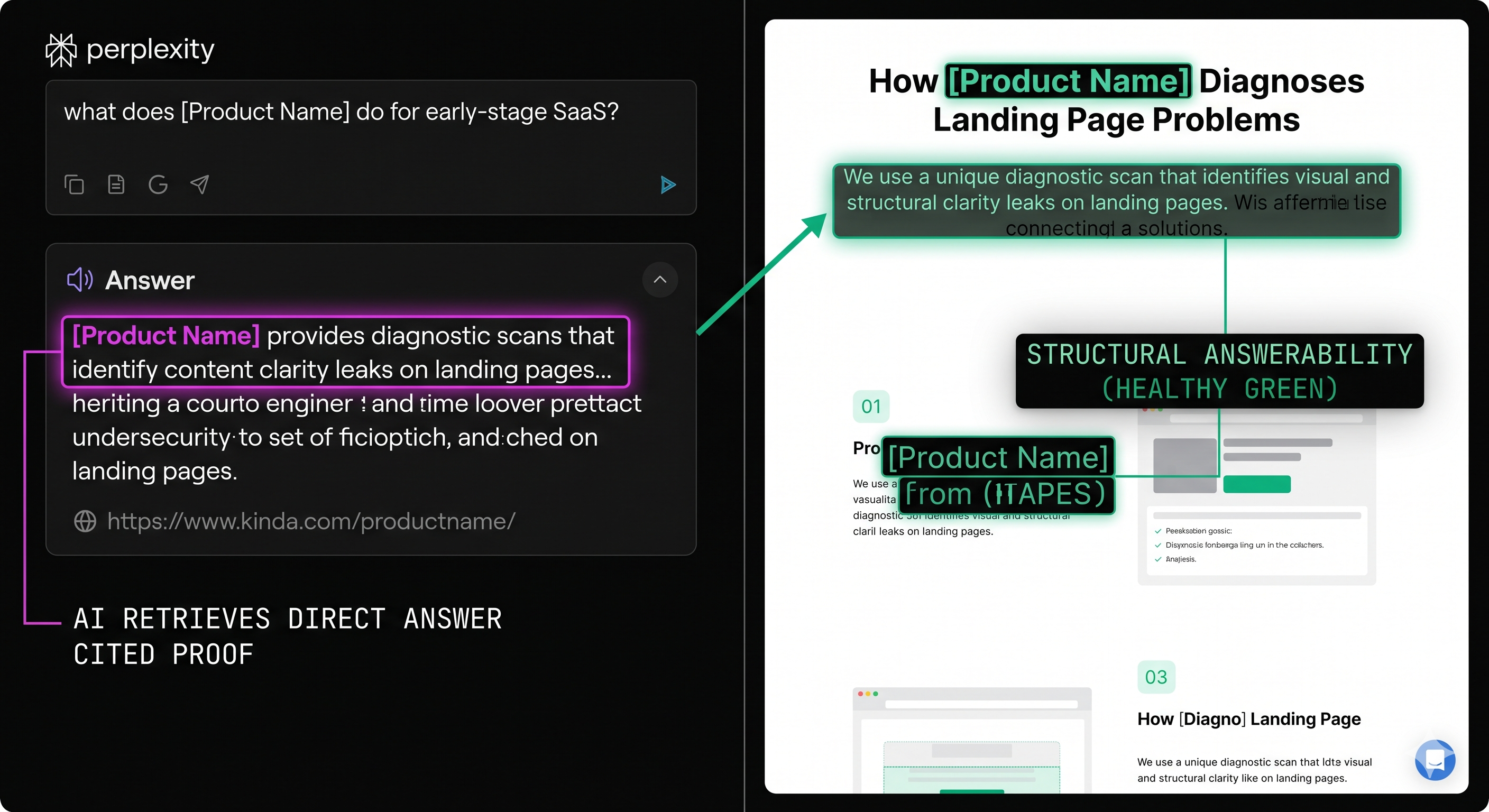
Here's what this looks like on a real page.
A SaaS founder had a well-ranked product page. Strong domain. Solid backlinks. Position two for a competitive keyword. The heading structure read: "The Platform," "How It Works," "Why It Matters," "Get Started." Every heading vague. None of them telling an AI engine what the product actually does.
The hero copy led with a tagline. Memorable to a human, completely unextractable to a machine. The actual explanation of what the product did appeared in paragraph three of the features section. No FAQ. Entity signals inconsistent between pages.
We changed four things: rewrote the H1 to name the product category and the audience explicitly, moved a two-sentence plain-English description of the product to the opening of the body copy, added eight FAQ entries phrased as real questions, and made the "who this is for" statement consistent across every page.
Within two weeks, Perplexity was citing the page as a primary source for two queries it had previously ignored entirely. The Google ranking didn't change. The retrieval did.
The gap isn't about quality. It's about structure.
Quick Diagnostic
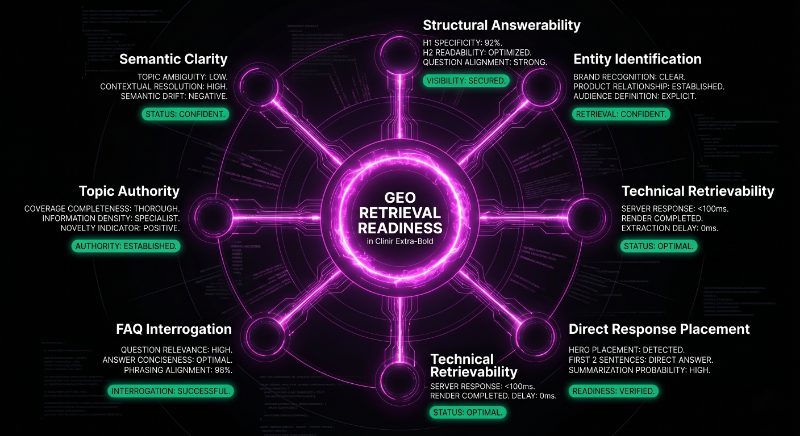
Run this against your most important page before anything else.
☐ Does your H1 clearly describe what the page is about — specifically, not cleverly?
☐ Do your H2s read as answers to questions people actually ask?
☐ Does the page answer "what does this do and who is it for" within the first two sentences of body copy?
☐ Is there a FAQ section — and does it use real questions phrased the way people actually ask them?
☐ Are your brand entity signals consistent across every page — who you are, what you do, who you serve?
☐ Could a machine extract a clear, citable answer from your page without reading every word?
☐ Does your content cover the topic thoroughly enough that an AI engine would treat it as authoritative?
☐ Are your headings descriptive enough to stand alone — would they make sense out of context?
Three Things to Do in the Next 30 Minutes
You don't need to rebuild the page. You need to fix the structure.
1. Rewrite your H1 and H2s. Make them descriptive and specific. If a heading could appear on any page in your industry, it's too vague. Name the category, the audience, or the outcome — explicitly.
2. Move your direct answer to the top. Find the sentence on your page that most clearly explains what you do and who it's for. If it's not in the first two sentences of body copy, move it there now.
3. Add or rebuild your FAQ section. Write eight to ten questions phrased exactly the way a potential customer would ask them. Answer each one directly, in two to four sentences. Place it before the footer.
Those three changes address the most common structural reasons AI engines skip pages. Do them before anything else.
Frequently Asked Questions
If my page ranks on Google, why isn't it being cited by AI engines? Because they use different retrieval logic. Google weighs authority signals. AI engines retrieve from content structure — clear headings, direct answers, entity clarity. A page can be strong on one system and invisible to the other.
Does this mean I should stop optimising for Google? No. Google optimisation and GEO aren't in conflict — they just require different things. Strong content that is clearly structured, directly answers questions, and has unambiguous entity signals performs well on both. The problem is pages that optimise for one without considering the other.
What's the fastest thing I can fix to improve AI visibility? Heading structure. Rewrite your H1 and H2s to be descriptive and specific rather than clever and vague. This is the single highest-leverage change for most pages — it costs nothing and improves retrievability immediately.
Does page length affect AI retrievability? Completeness matters more than length. A short page that directly answers the question it's addressing is more retrievable than a long page that buries the answer in persuasive copy. That said, thin content signals low authority to AI engines. Cover the topic properly. Don't pad.
Do schema markup and structured data help? Yes, but they're not a substitute for content clarity. Schema helps AI engines understand context — but if the underlying content is structurally poor, schema won't fix it. Get the content structure right first. Schema is a reinforcement, not a foundation.
The Gap Closes With Structure
Google ranking and AI visibility are two different problems. Most pages are only solving one of them.
The fix isn't a full rebuild. It's structural. Descriptive headings. Direct answers placed early. A FAQ section that treats real questions seriously. Consistent entity signals throughout.
Pages built for humans and structured for machines get cited. Pages built only for Google's ranking signals get skipped.
If you want to see exactly where your page sits — which GEO dimensions are failing and what to change — run a free GEO audit at conversiondoc It takes 60 seconds.
Written by Dean Carney — Founder of ConversionDoc. Conversion strategist helping founders, freelancers, and agency owners diagnose why their pages aren't converting — and fix them. Connect on LinkedIn