By Dean Carney — Founder of ConversionDoc
Most landing pages fail not because of bad design or weak offers, but because the people who built them are too close to see what's broken. Change blindness — a well-documented cognitive psychology principle — means founders stop seeing their own pages clearly after repeated exposure. This article explains why conversion failure is almost always invisible from the inside, introduces the seven conversion pillars used to diagnose underperforming pages, and shows what a proper diagnosis makes possible.
Here is the short answer: your landing page is probably failing because of change blindness, structural friction, or missing trust signals — and because you have looked at it too many times to see any of them clearly.
That is not a criticism. It is a cognitive reality that affects almost every founder who builds or briefs their own page.
The longer answer is worth understanding — because once you see the pattern, you cannot unsee it.
You've Done Everything Right. It Still Isn't Converting.
You tweaked the headline. Changed the button colour. Maybe rewrote the copy once or twice.
You ran ads to it, shared it in communities, asked people what they think.
And it still isn't converting.
The frustrating part is not the result. It is not knowing why. There is no error message. No clear signal.
Just traffic arriving and leaving without doing what you built the page to make them do.
The instinct is to keep tweaking — try a new headline, test a different CTA, move things around. But optimising by feel rarely works.
Not because the changes are wrong. Because the diagnosis never came first.
Why You Can't See It From the Inside
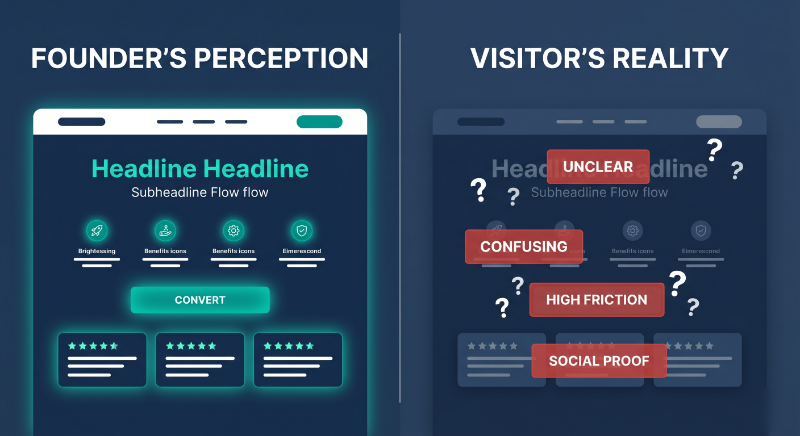
There is a well-documented phenomenon in cognitive psychology called change blindness — the tendency to fail to notice problems in things you have been repeatedly exposed to.
It explains why writers miss typos in their own work. Why engineers overlook bugs in their own code.
And why founders stop seeing what is broken on their own landing pages.
When you have looked at a page dozens of times, your brain stops processing it as new information. It fills in gaps from memory. It reads what it expects to see rather than what is actually there.
The page that confuses a first-time visitor reads as perfectly clear to the person who built it — because that person already knows what it means.
💡 Pro Tip: This is not a personal failure. It is a fundamental feature of human cognition — and it has a direct, measurable effect on conversion rates.
Research from Nielsen Norman Group consistently shows that the people closest to a product are the least reliable evaluators of its clarity and usability. Fresh eyes see friction that familiar eyes stopped registering long ago.
In almost every audit I run, the founder is convinced the page is clear. The visitor data tells a different story.
The 5-Second Problem
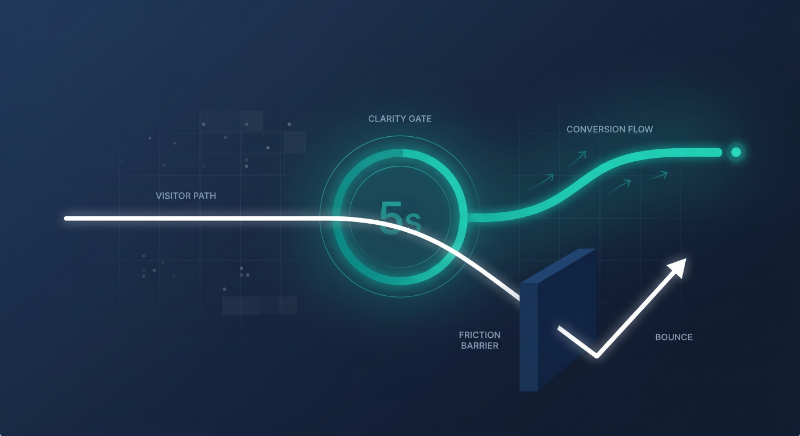
Compound change blindness with this: visitors make a stay-or-leave decision within seconds of arriving on a page.
Research into web user behaviour consistently shows that attention is allocated almost immediately. If a visitor cannot understand what the page is about, who it is for, and why it matters — within the first few seconds — they leave.
Most persuasion never gets a chance to work because the clarity threshold was never cleared.
This creates a specific diagnostic trap. The founder reads the page and finds it perfectly clear. The visitor arrives, cannot orient, and leaves.
The founder sees the exit rate and concludes the headline needs work. They rewrite it. The underlying problem stays untouched.
⚠️ Warning: The issue is almost never the words. It is the structure, the hierarchy, the trust signals — or the absence of them. Rewriting the headline without diagnosing the structure first is the most common and most expensive mistake I see.
The 7 Conversion Pillars: A Diagnostic Framework
Get your free audit - Now
Conversion failure is rarely caused by one thing.
It is usually a combination of issues spread across the page — each individually manageable, collectively enough to kill performance.
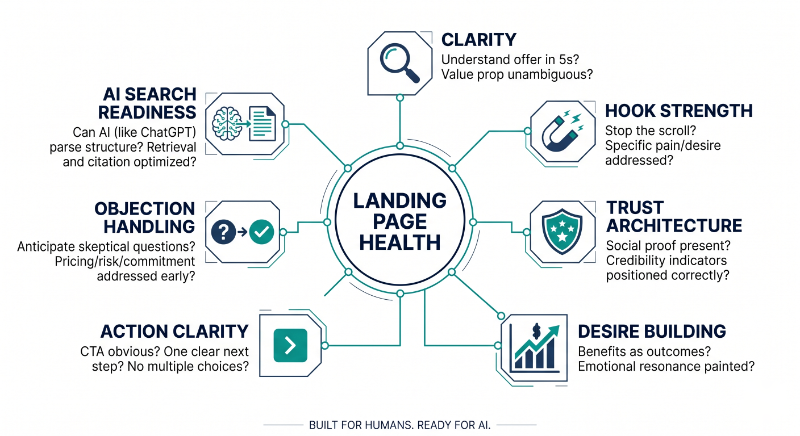
Every audit I run at ConversionDoc covers seven conversion pillars. Not as a sales exercise — as a genuine diagnostic lens that breaks a complex problem into addressable components.
Here is what each pillar looks at:
1. Clarity — Can a first-time visitor understand your offer within five seconds? Is the value proposition specific and unambiguous? Or does the page require the visitor to work out what it means?
2. Hook Strength — Does the headline stop the scroll? Does it speak to a specific pain or desire? Or does it describe a product category and leave the visitor unmoved?
3. Trust Architecture — Is there social proof? Are credibility indicators present and correctly positioned? Is there anything on the page that reduces the perceived risk of taking action?
4. Desire Building — Are benefits framed as outcomes for the customer? Is there emotional resonance? Does the page paint a picture of what changes after someone buys or signs up?
5. Action Clarity — Is the call to action obvious? Is there one clear next step? Or does the page offer multiple directions — which usually means visitors choose none of them?
6. Objection Handling — Does the page anticipate the questions a sceptical visitor would ask? Are pricing, risk, and commitment concerns addressed before the visitor goes looking for answers elsewhere?
7. AI Search Readiness — Can an AI search engine like ChatGPT or Perplexity read, understand, and summarise what this page is about? Is the structure clear enough to be retrieved and cited?
Most underperforming pages have issues across three or four of these pillars simultaneously. Which is exactly why individual tweaks so rarely move the needle.
The Two Most Common Failure Points
Of the seven pillars, two consistently produce the highest conversion losses on self-built pages.
Clarity failure is the most common by a distance.
The founder understands the offer completely — so the page was written for someone who already understands it. The headline uses internal language. The subheadline assumes context the visitor does not have.
I see this pattern constantly: copy that explains features before establishing why those features matter. A first-time visitor arrives, cannot immediately orient, and leaves before anything else has a chance to work.
Missing trust architecture is the second.
Many self-built pages have no social proof at all — or have it buried so far down the page that most visitors never reach it.
According to research from BrightLocal, the vast majority of consumers read reviews before making a purchasing decision. Yet landing pages routinely bury testimonials below the fold, use vague praise without specific outcomes, or omit credibility signals entirely from the areas that receive the most attention.
💡 Pro Tip: Trust signals do not just need to exist. They need to be above the fold, specific, and outcome-based. "Great tool!" is not social proof. "Increased our trial-to-paid conversion by 22% in six weeks" is.
These two issues alone account for a significant proportion of conversion losses on pages that are otherwise well-intentioned and well-designed.
What a Proper Diagnosis Changes
The difference between tweaking by feel and diagnosing properly is the difference between treating symptoms and treating causes.
When you know which of the seven pillars is failing — and specifically how — the fix becomes obvious.
A clarity problem has a different prescription to a trust problem. A weak hook requires different treatment to a missing objection response.
Diagnosis first. Then treatment.
This is the same logic a doctor applies. You do not prescribe medication before you know what is wrong. You run the tests, identify the issue, then act with precision.
The same principle applies to landing pages. The page is not failing randomly. It is failing for specific, identifiable, fixable reasons.
The goal is to find them — and that requires a diagnostic lens that proximity to the page cannot provide.
The Headline Is a Symptom, Not the Cure
The conventional wisdom in landing page optimization is to "start with the headline." We’re told to tweak the copy, A/B test power words, and hunt for that magic string of text that will suddenly unlock a 10% lift.
The Contrarian Reframe: Headline testing is a waste of time if your structure is broken.
In the majority of underperforming pages I audit, a weak headline isn’t the root cause—it’s a symptom of a deeper positioning failure . If you don't know exactly who you’re talking to or what specific friction you're solving, rewriting the headline is just putting fresh paint on a collapsing house. You’ll end up with a "better" sentence that still fails because it lacks a structural foundation.
The truth? Bias is a tax. When you refuse to see your page’s structural flaws because of "Change Blindness," you are effectively paying a 20% premium on every ad click.
The actual issue is almost always Architectural :
- Information Hierarchy: You’re answering questions the visitor hasn't asked yet while ignoring the ones keeping them from clicking.
- Misplaced Trust: You have social proof, but it’s positioned where no one looks.
- Friction-Heavy CTAs: Your button is asking for a marriage proposal when the visitor just wanted to say hello.
How to Fix It: Stop obsessing over the words. Fix the structure first. Once the path from confusion to confidence is paved, the headline often fixes itself—because for the first time, you actually know exactly what it needs to say to move the needle.
Quick Diagnostic: Is Your Page Failing One of the 7 Pillars?
Run through these before you change anything else:
- Can a stranger describe your offer accurately after five seconds on the page?
- Does your headline speak to a specific outcome or desire — not a product category?
- Is there visible social proof or a credibility signal above the fold?
- Are your benefits framed as outcomes for the customer, not features of the product?
- Is there one clear CTA with no competing actions?
- Does the page address at least two common objections before the visitor has to ask?
- Could an AI search engine read and summarise this page accurately?
If you answered no to two or more, your page has a diagnosable conversion problem — and it is almost certainly not the one you have been trying to fix.
Frequently Asked Questions
Why does my page look fine to me but not convert? Because you built it. The more familiar you are with a page, the less reliably you can evaluate it as a first-time visitor would. This is change blindness in action — a well-documented cognitive psychology principle. Your brain fills in gaps from memory rather than processing the page fresh. A structured external audit removes that bias and shows you what new visitors actually see.
Is conversion rate optimisation only relevant for high-traffic pages? No. Fixing conversion issues on low-traffic pages often produces a bigger return than increasing traffic to a broken one. If your page converts at 1% and you double your traffic, you double your cost with the same poor return. Fix the conversion rate first, then scale the traffic.
What is the most common conversion mistake on self-built landing pages? Clarity failure — writing for someone who already understands the offer. Self-built pages are almost always written from the inside out. The visitor arrives with no context and cannot orient. The fix is not a better headline — it is rebuilding the page from the visitor's perspective, starting with the question they are actually asking: "Is this for me, and is it worth my attention?"
How do I know if my trust signals are strong enough? Ask whether a sceptical stranger — someone who has never heard of your product — would find enough evidence on the page to feel safe taking action. Look specifically at whether testimonials include specific outcomes, whether credibility indicators appear above the fold, and whether the CTA reduces perceived risk rather than increasing it.
Does page structure affect AI search visibility? Yes, directly. AI search engines like ChatGPT and Perplexity retrieve and summarise content based on how clearly it is structured and how directly it answers likely questions. A page with vague headings, buried key information, and no FAQ structure is difficult for AI systems to parse — which reduces the chance of it being cited or surfaced in AI-generated answers. Conversion clarity and AI search readiness are more connected than most founders realise.
What to Do Next
Before you rewrite the headline again, change the button colour, or run more traffic to the same page — find out which of the seven pillars is actually failing.
Most conversion problems are specific and fixable. But they are invisible from the inside.
The page that looks clear to you reads as confusing to the visitor who just left without converting.
Run a free audit on your landing page at ConversionDoc. You will get a conversion score across seven dimensions, your top three critical fixes, and a clear picture of where your page is losing people — in 60 seconds.
Written by Dean Carney, Founder of ConversionDoc. Conversion strategist helping founders, freelancers, and agency owners diagnose why their pages aren't converting — and fix them.